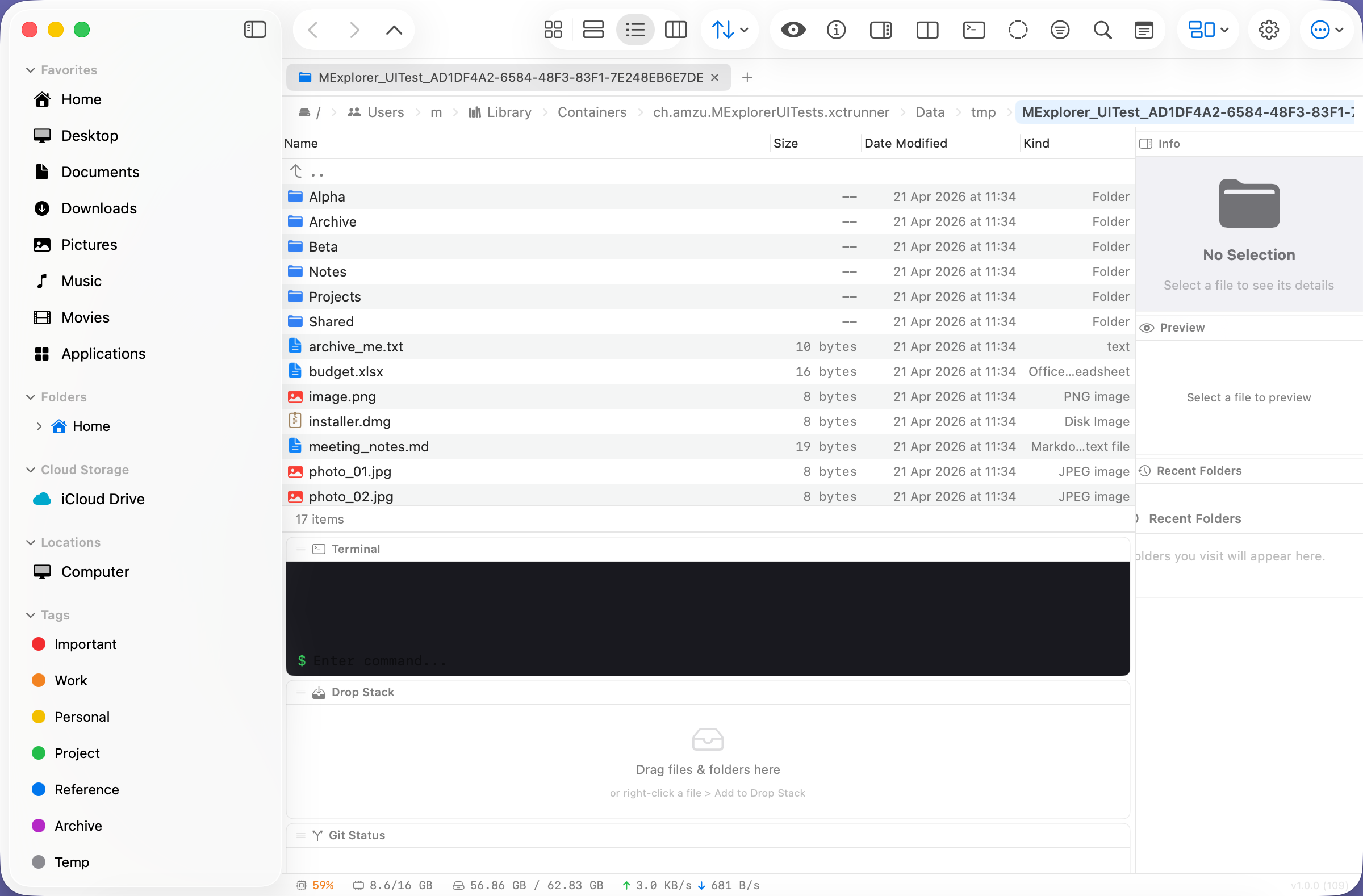
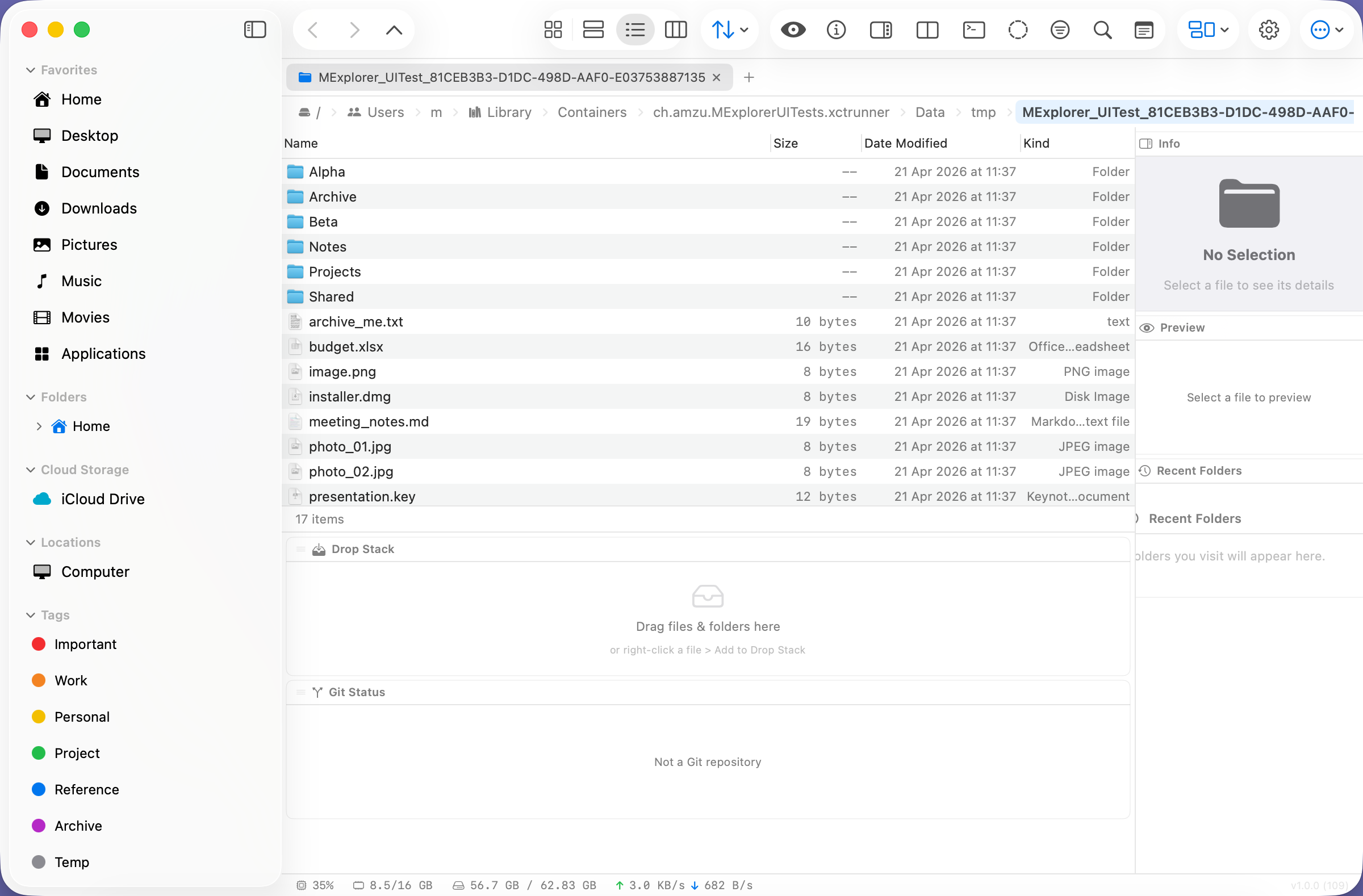
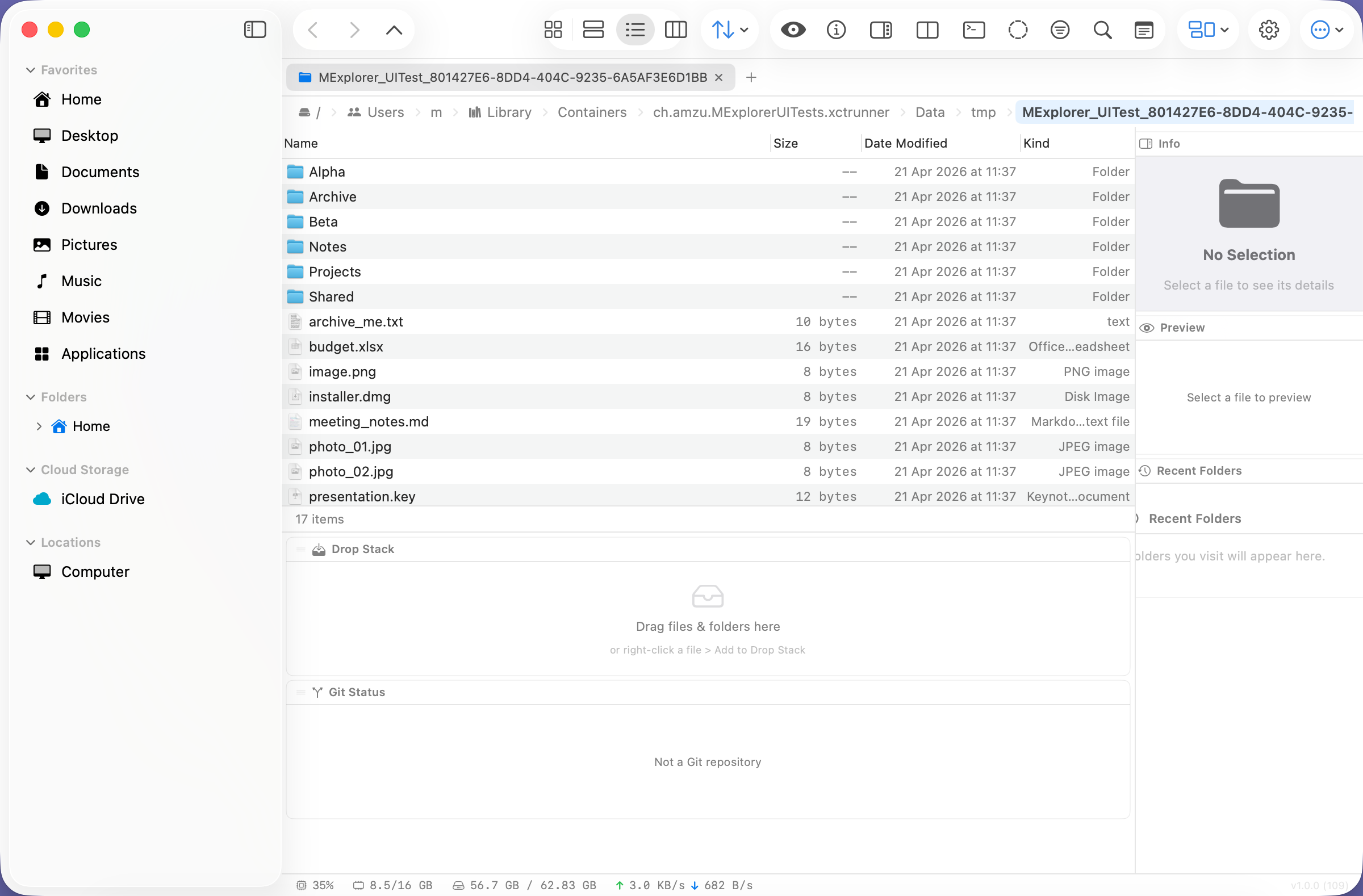
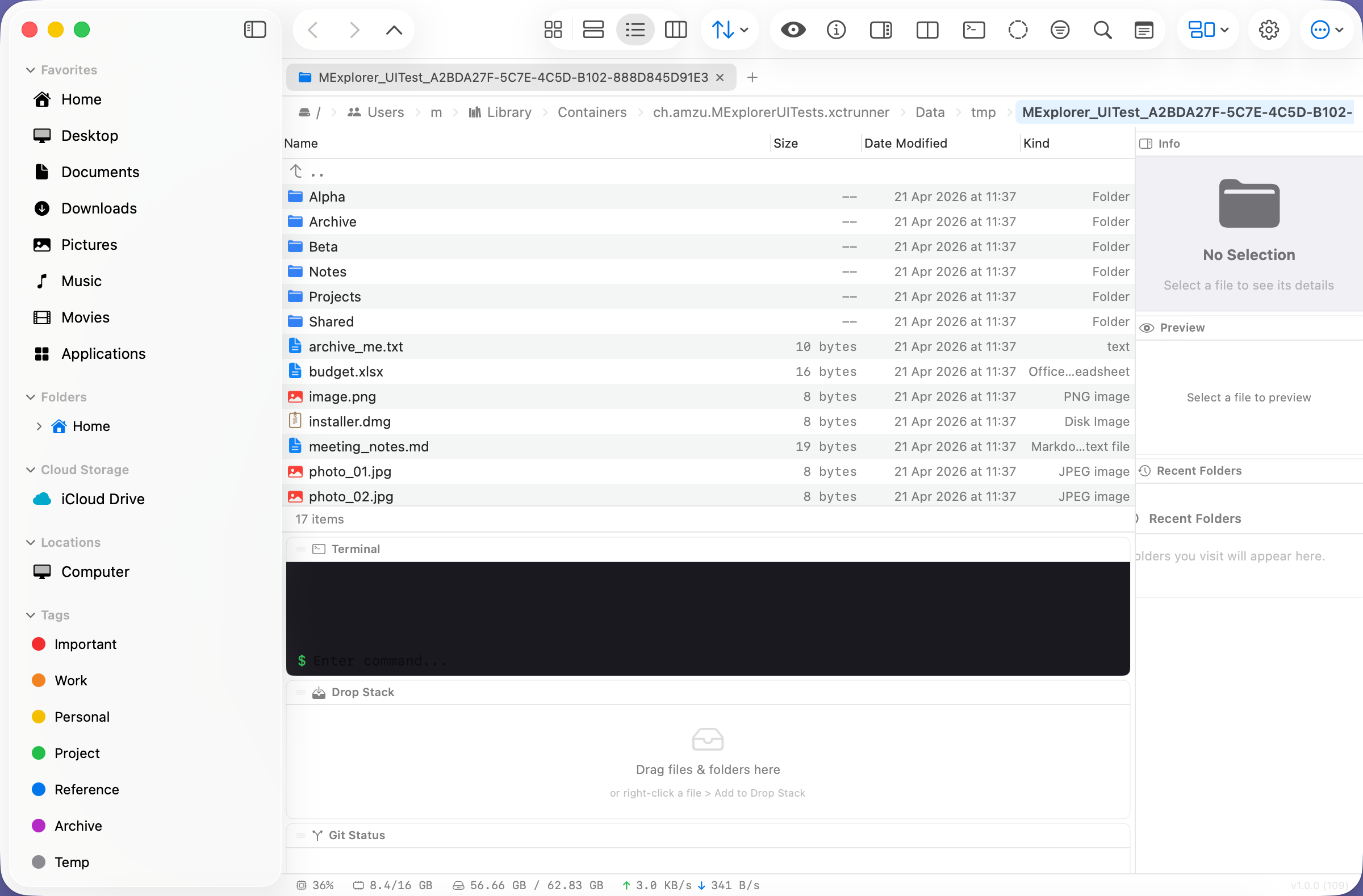
Eleven one-click profile presets modelled on Finder, Windows Explorer, Dolphin, Nautilus, Total Commander or Directory Opus. FileZilla-style server manager with Keychain passwords. Batch rename, checksums, Miller columns, Commander F-keys — built natively for macOS.
Why MExplorer
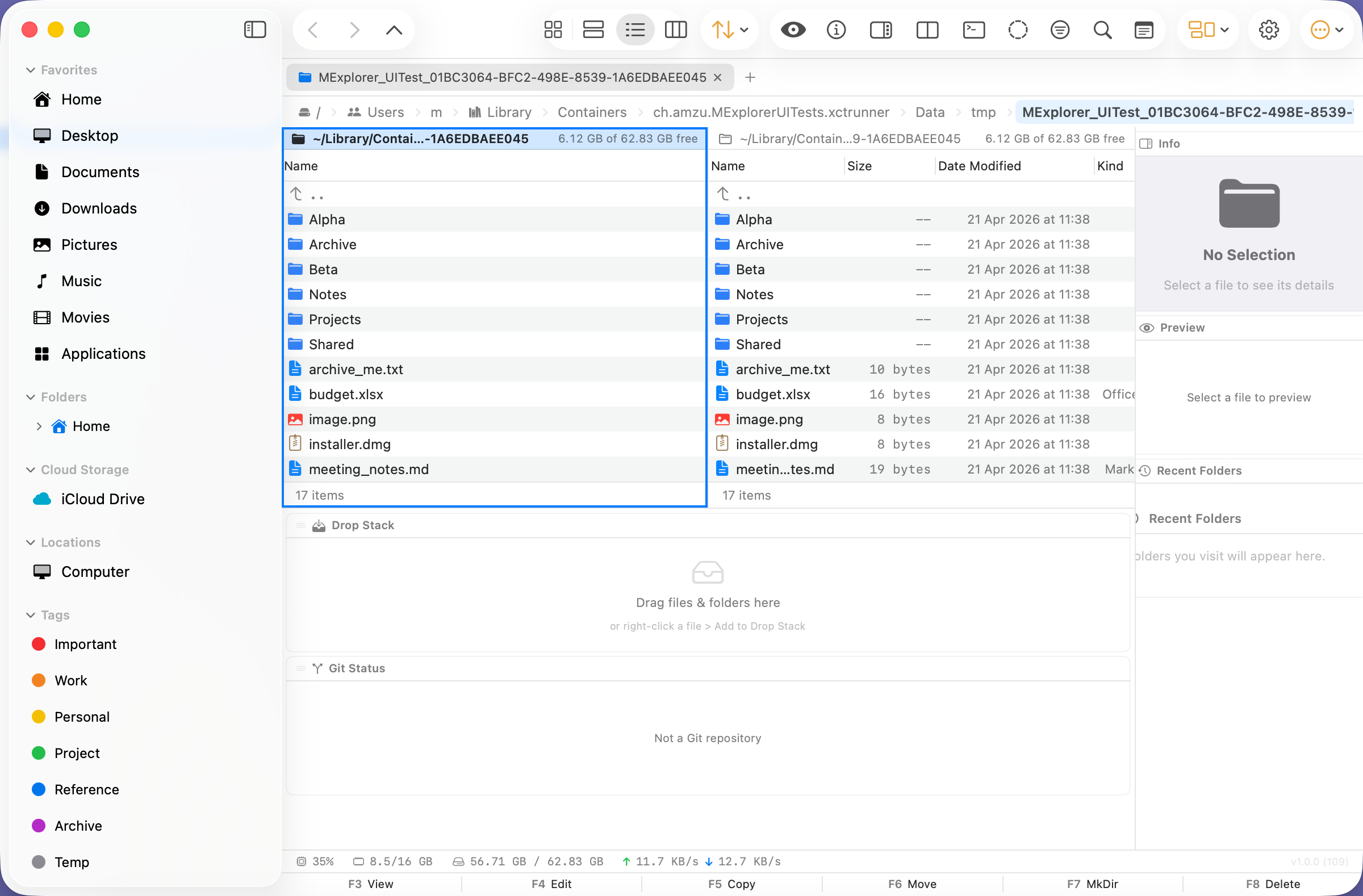
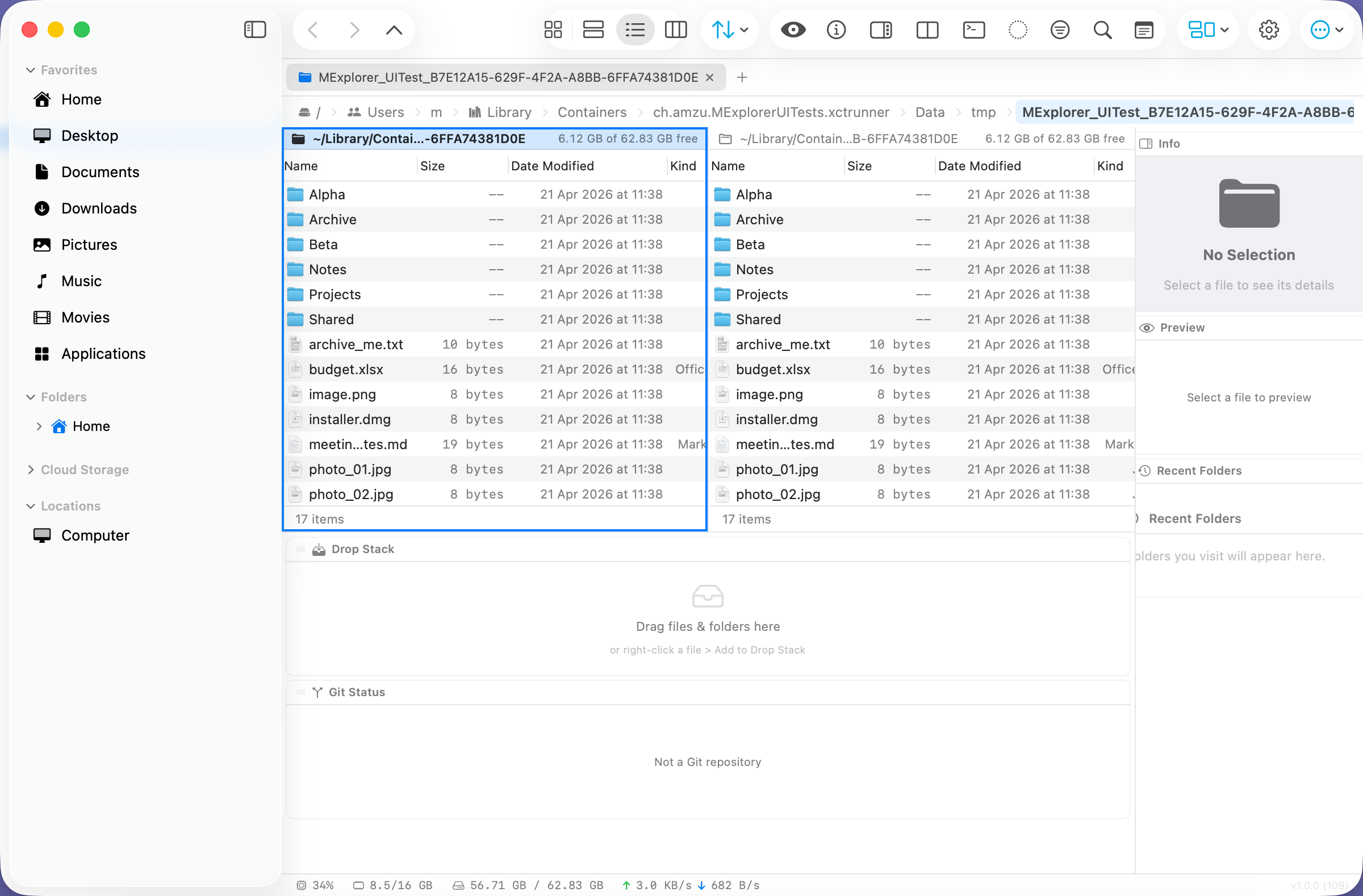
Open as many tabs as you need. Split any tab into two panes to copy or move between folders without losing your place.
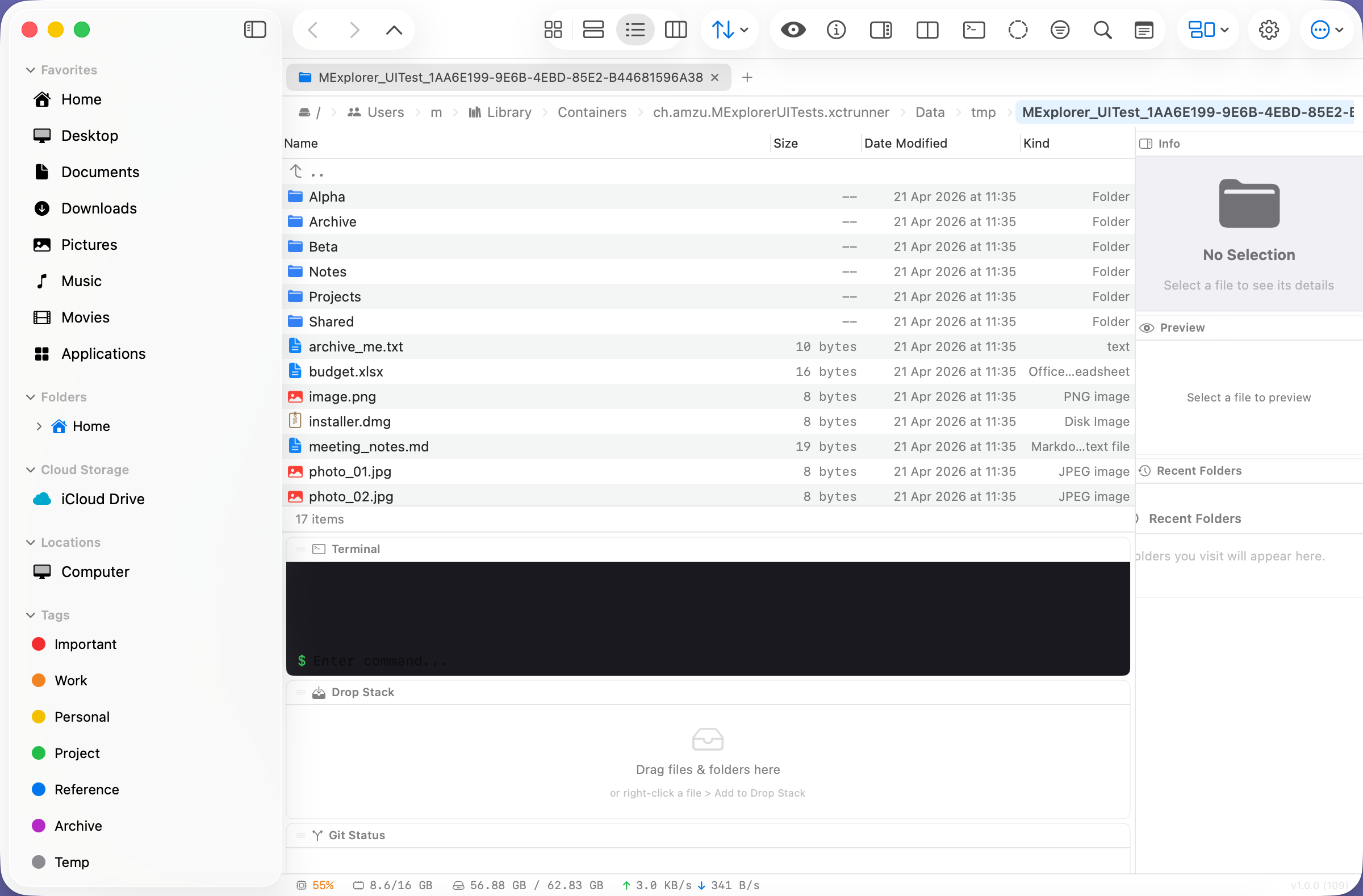
Edit → Batch Rename… (⌘↩): find & replace (with regex), sequential numbers, added text, date/time and case changes. Live preview with collision detection before you commit.
Auto-detects text, hex dump, and image files. Zoom, fit-to-window, slideshow and arrow-key navigation for images.
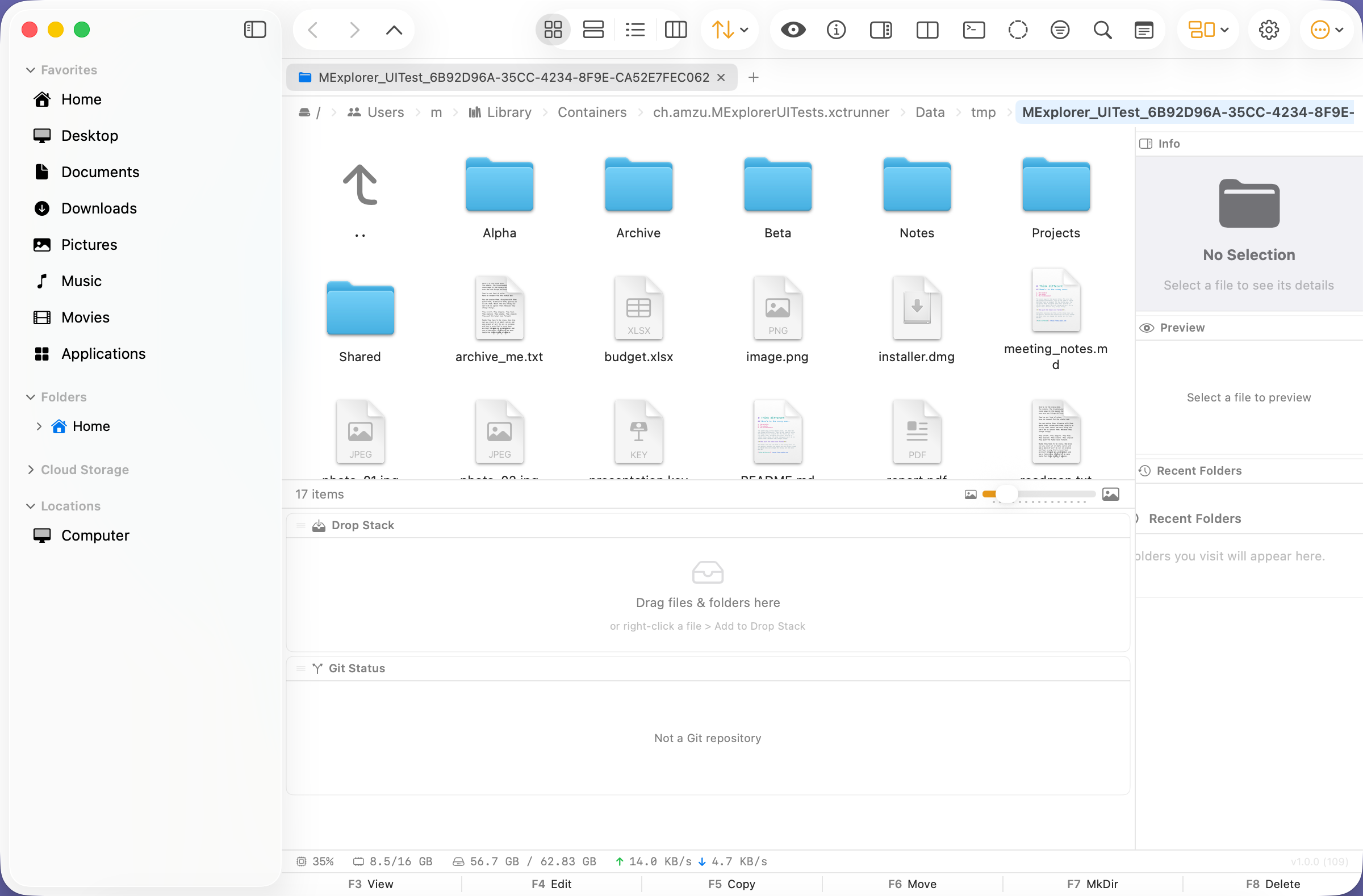
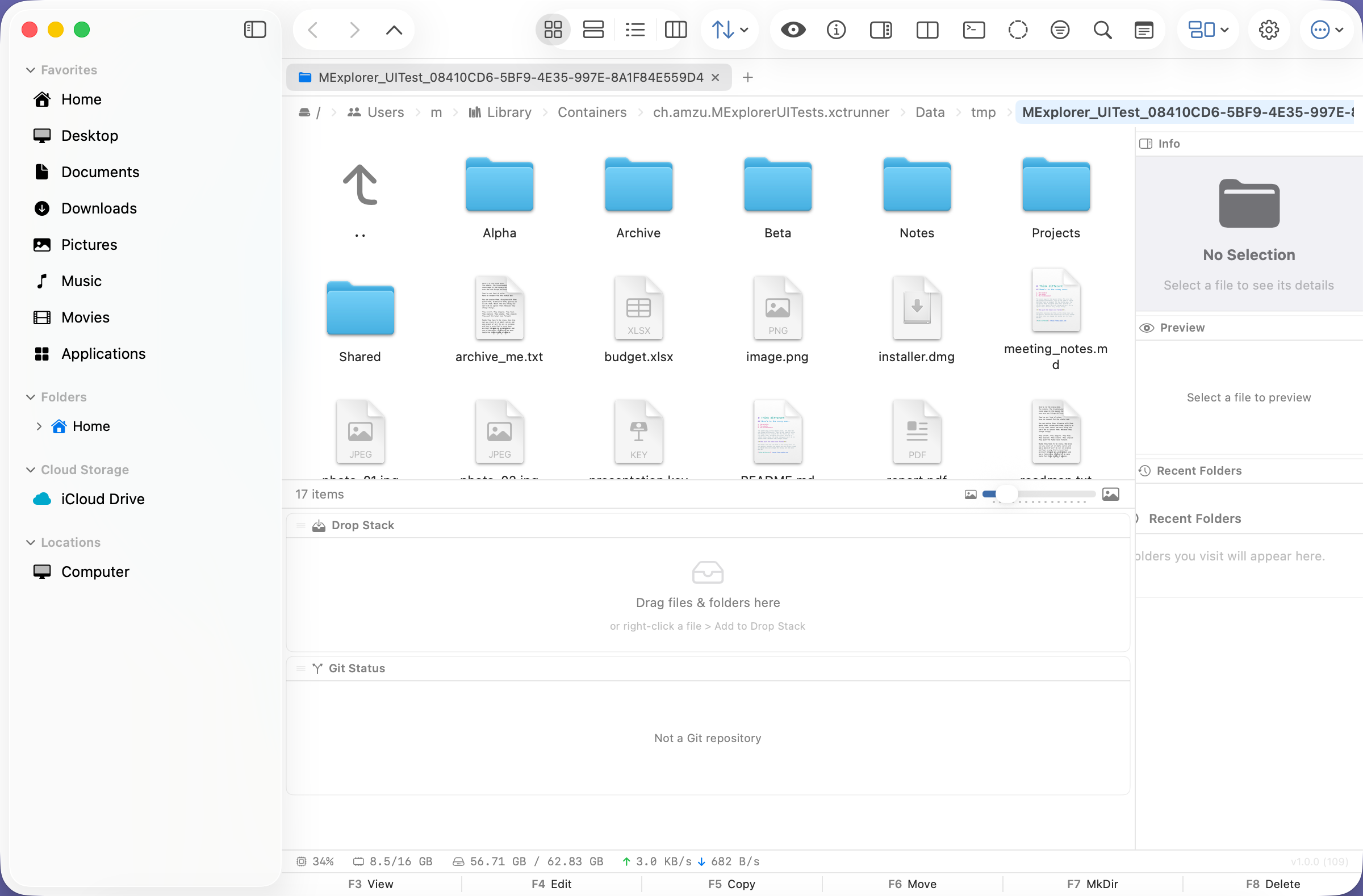
Image-focused browsing with a size slider (64–512 px). QuickLook thumbnails, bounded memory, bucketed cache for instant rescans.
Select a folder and the Info panel works out its total size, recursively.
Press Ctrl+I (or the Filter button) and type to narrow the list. Plain text matches the start of names; prefix with * for substring mode, use ? for single-char wildcards.
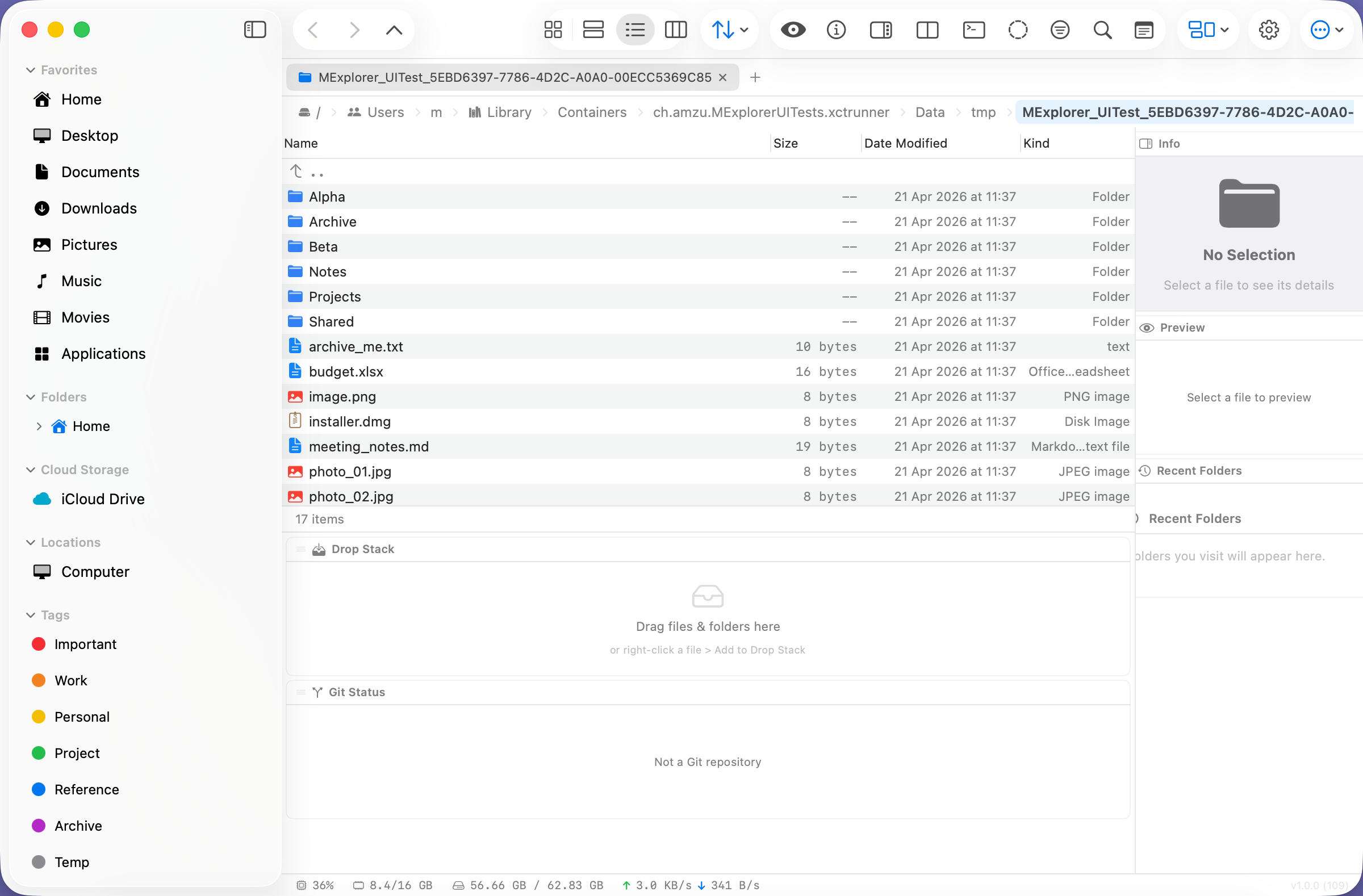
Drag any file onto a sidebar tag to apply it. Click a tag to see every file you’ve tagged in MExplorer, wherever it lives. Right-click → Tags to toggle individually or New Tag… inline. Tags and star ratings are now separately toggleable features.
A right-panel module keeping the last N folders you visited, MRU-ordered. One click jumps the active pane there. Settings → Recent Folders controls the row count (1–50) and has a Clear History button.
F3 opens the built-in viewer; .md files render with proper headings, lists and code blocks, and PDFs open through PDFKit with page navigation, zoom and text selection. No QuickLook round-trip.
The Info panel includes a Hashes section with MD5, SHA-1, SHA-256 and SHA-512. Compute per algorithm on demand, copy digests to clipboard, or Save Sidecar to drop a file.sha256 in shasum format next to the file.
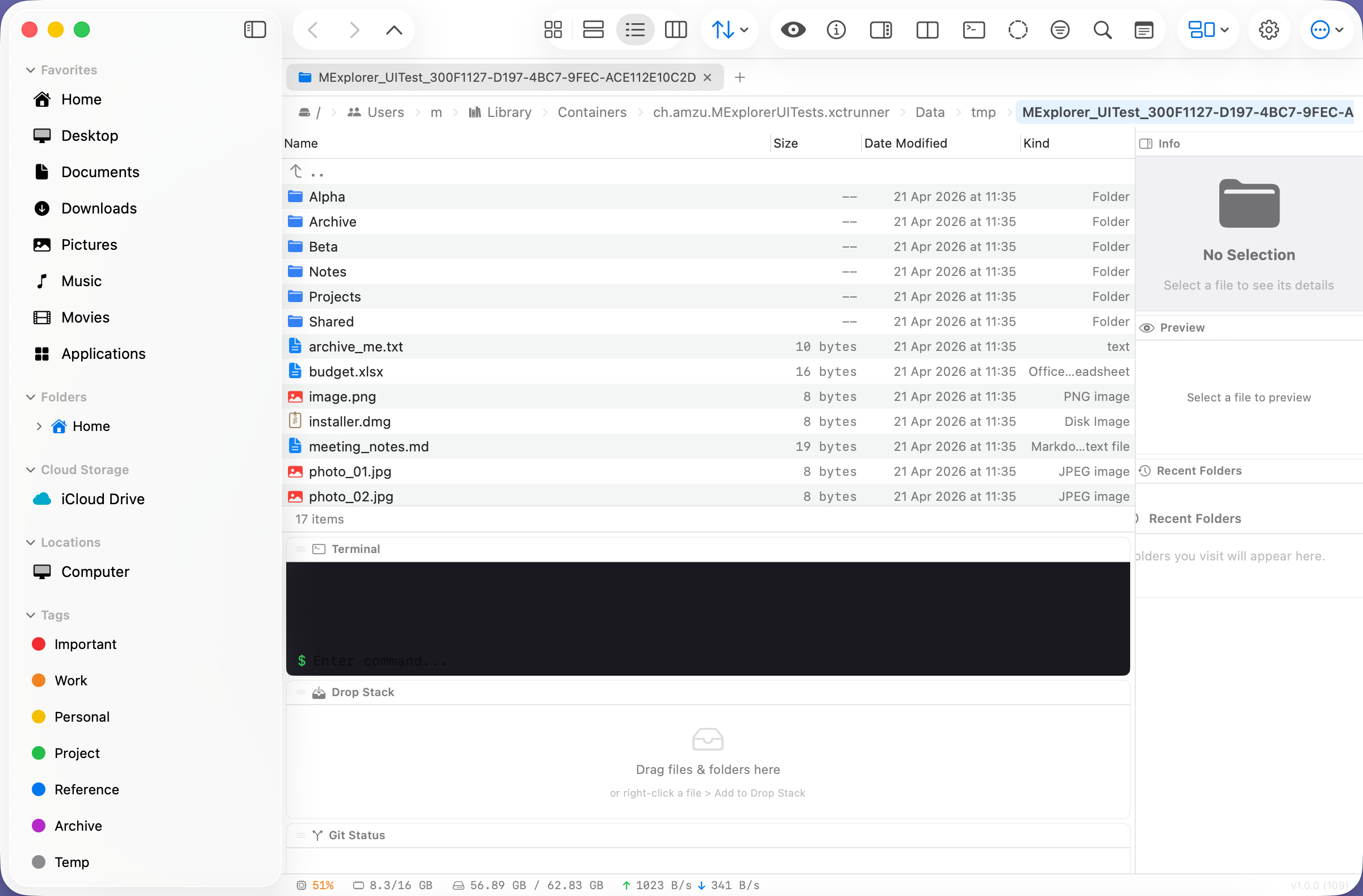
Every section — Favorites, Folders, Cloud, Locations, Tags, Ratings, Modules — is individually collapsible. Click the title or chevron; the state persists across launches.
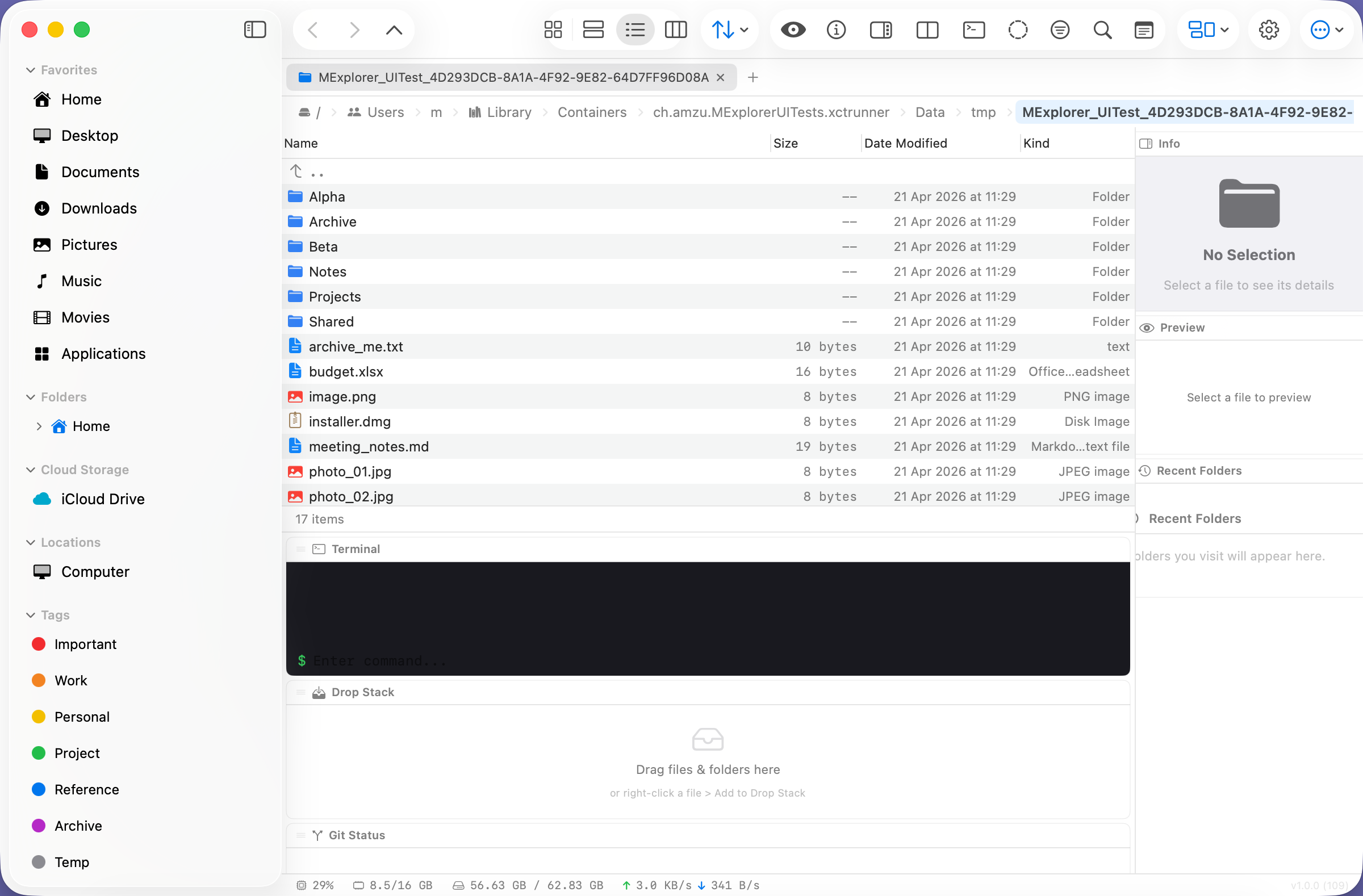
Category-tinted SF-Symbol icons for folders, images, videos, audio, documents, archives, code and executables. Monochrome fallback is one toggle away.
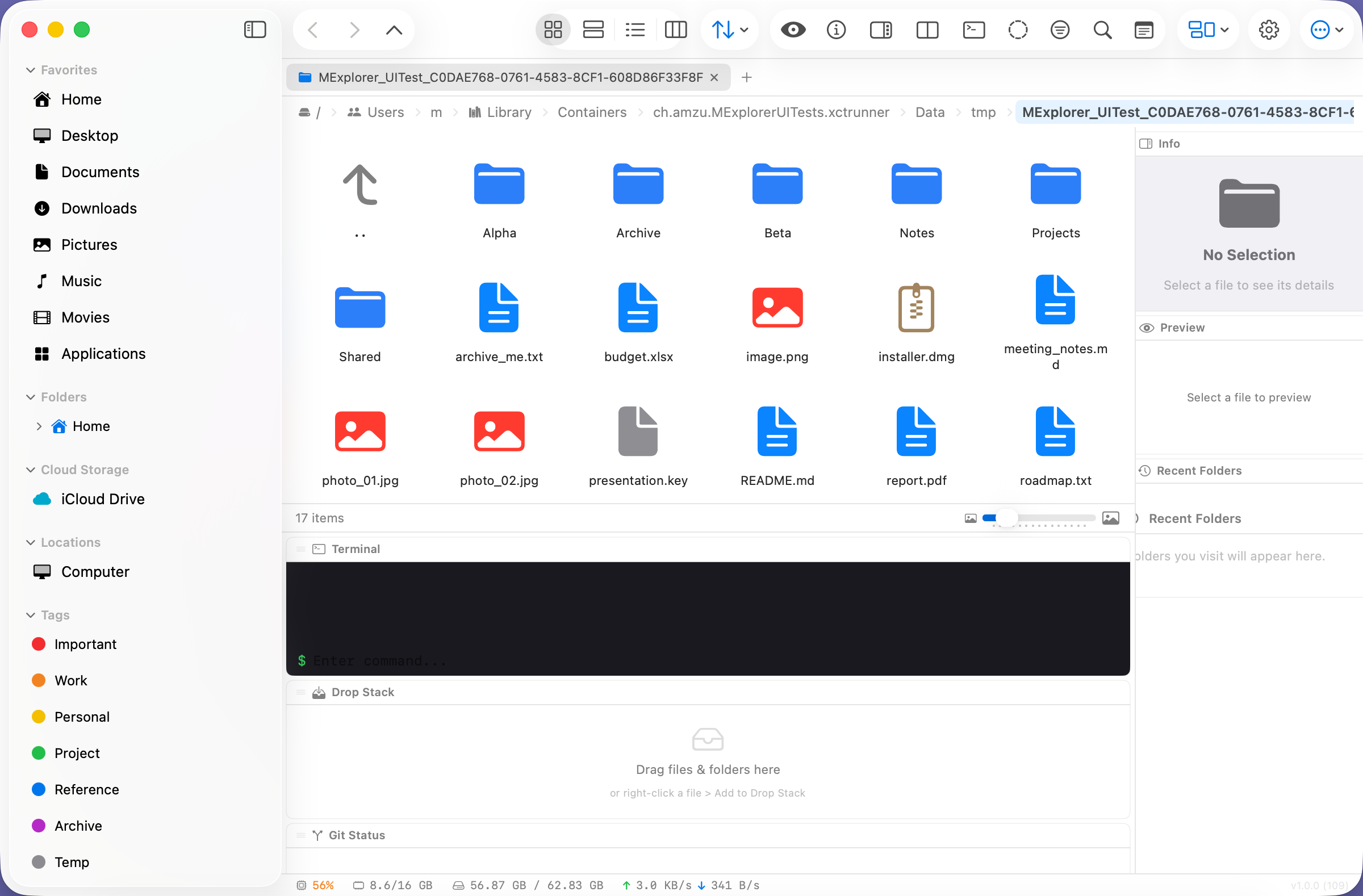
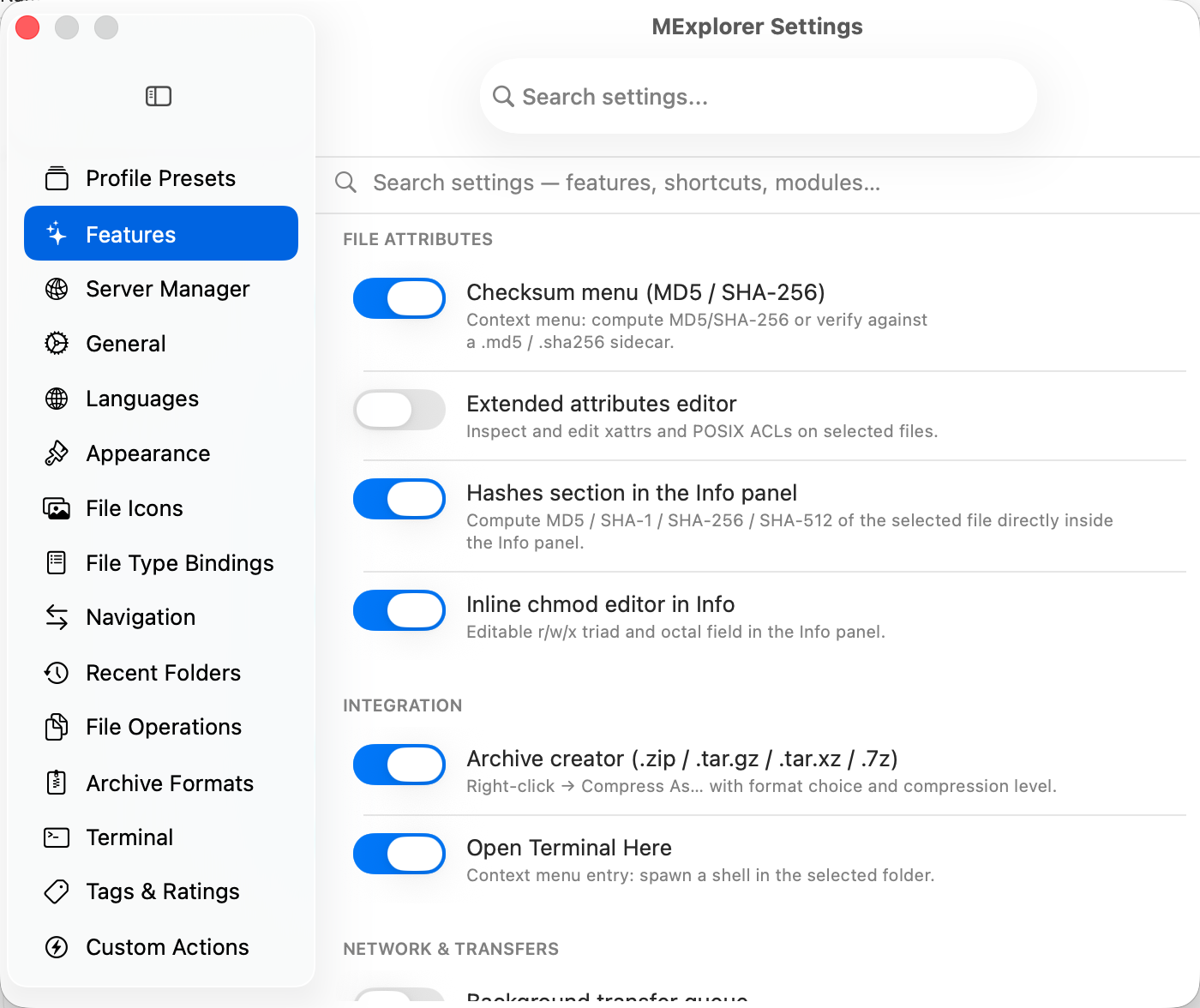
Settings → File Type Bindings lets you edit which extensions map to which category (Images / Videos / Audio / Documents / Archives / Code / Executables) — add webp to images, move dmg out of archives, or reset a row to defaults.
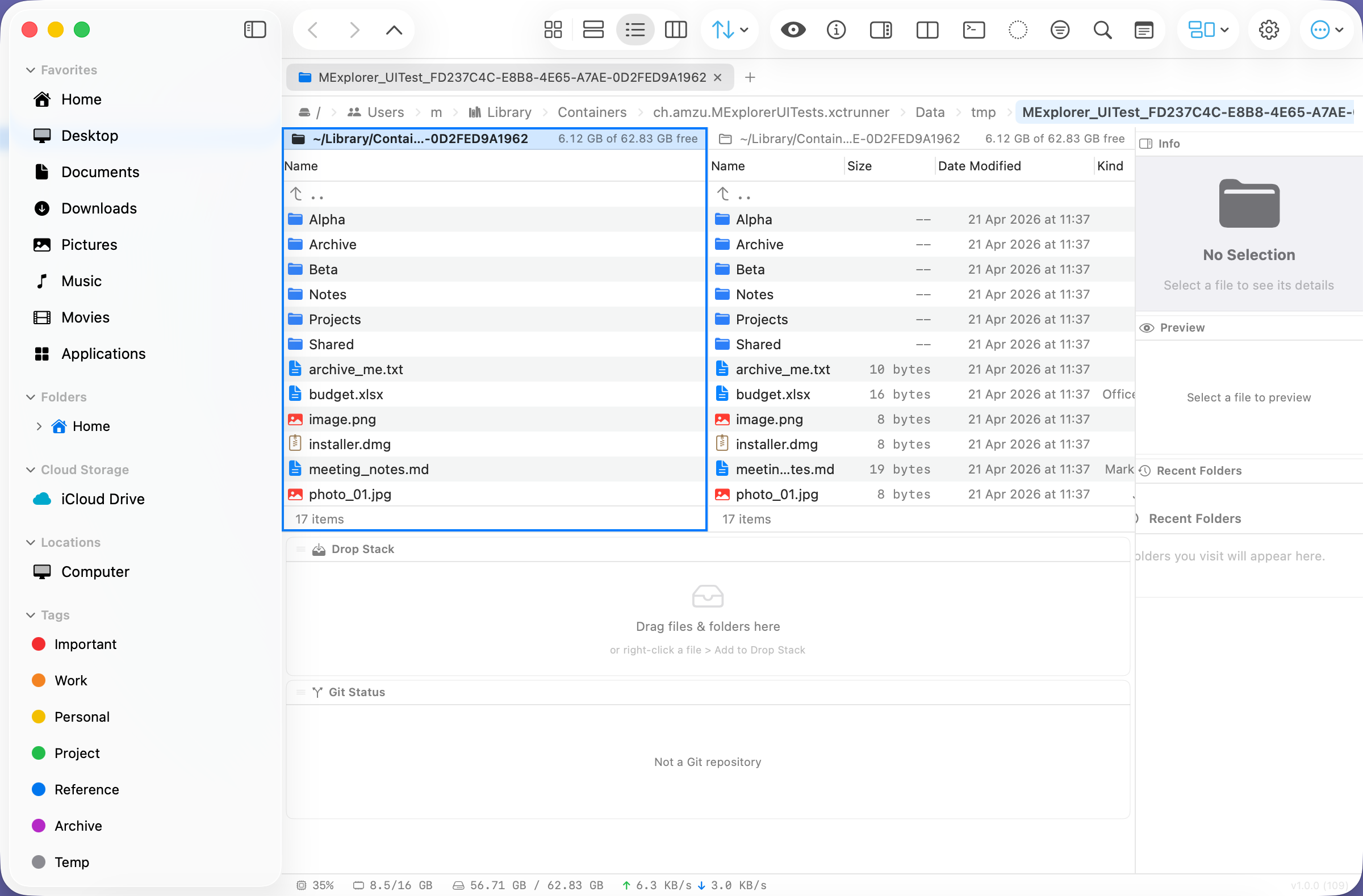
Active pane gets an accent-coloured border so you always know which side your keystrokes hit. Each pane shows a bold path + free-space header. Right-panel toggle (⌘⌃D) symmetric with the sidebar toggle (⌘⌃S).
Settings → Backup & Reset exports every preference to JSON, imports them back, or resets to factory defaults with a confirmation. An auto-snapshot is written to ~/Library/Application Support/MExplorer/settings.json on quit.
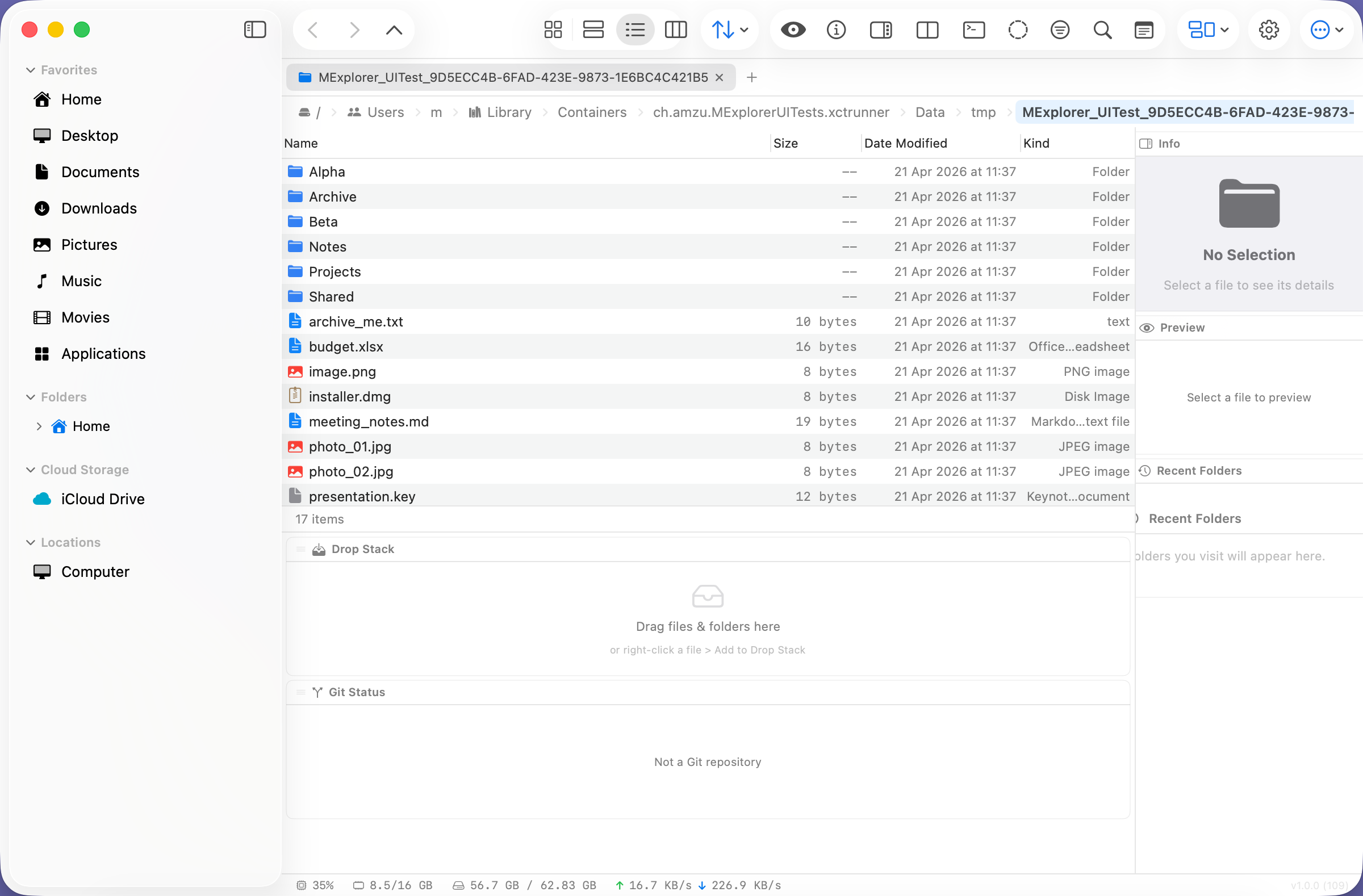
Sort by Date Modified or Date Created and MExplorer drops the folders-first grouping, producing a single interleaved timeline — the literal most-recent item lands at the top, file or folder. Sort by Name / Size / Kind keeps folders-first.
⌘F focuses the search field with an accent-coloured border so you can start typing immediately. Globs supported: *.html, report?.pdf. Deleting the query restores the full list without pressing the X.
iCloud Drive, Google Drive, OneDrive and Dropbox are detected automatically and surfaced in the sidebar.
Right-click → Properties… opens a full sheet with POSIX r/w/x triad, octal field, and an explicit Executable (owner) toggle so you don’t need to drop into Terminal.
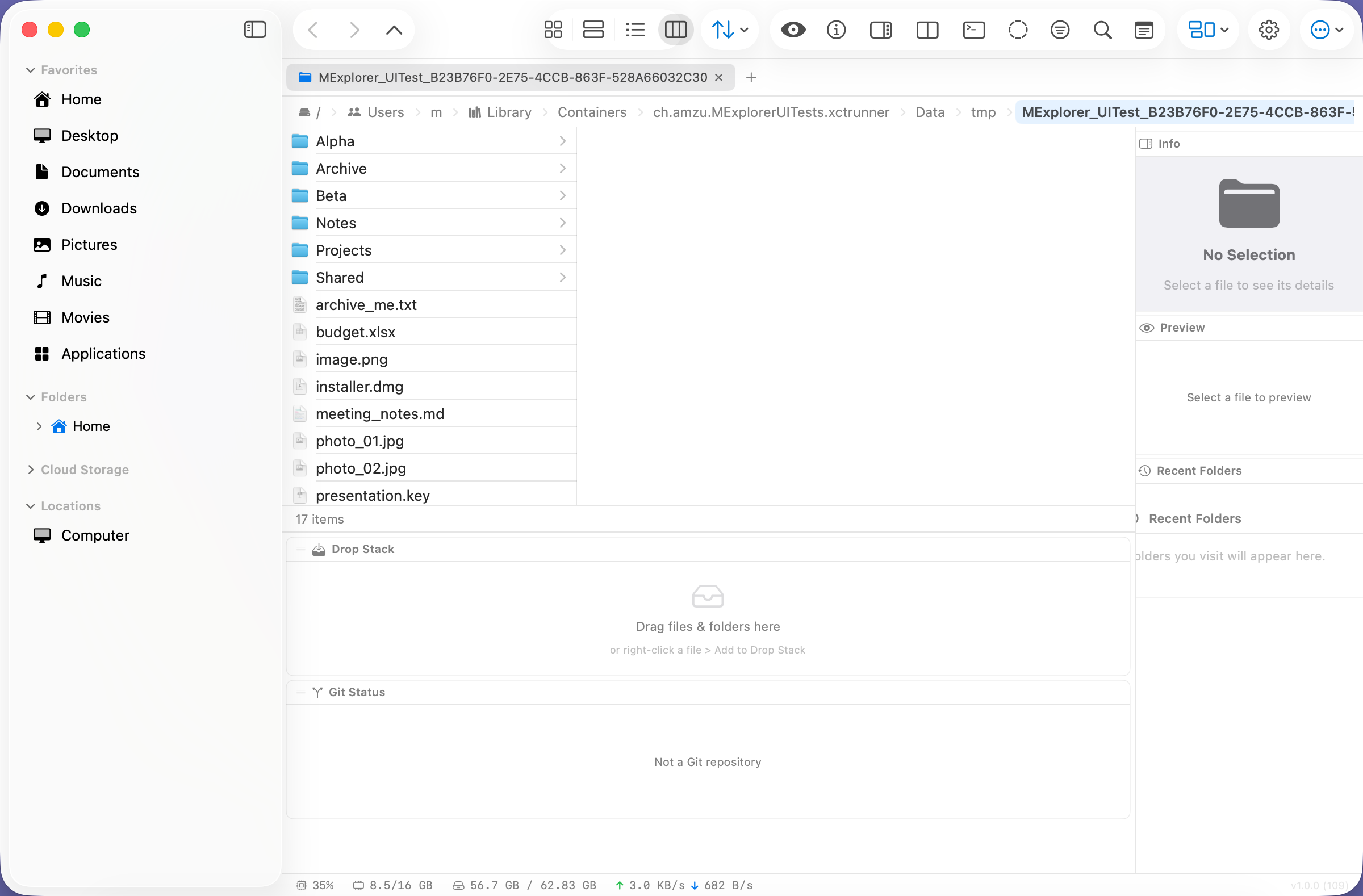
Finder-style cascade of columns. Select a folder and a new column opens to the right, ready for a deeper dive. Off by default — switch it on in Settings → Features, then use ⌘4.
Optional (off by default) F3 view, F4 rename, F5 copy / F6 move to the other pane, F7 new folder and F8 trash — muscle memory carried over from Total Commander and Norton.
View mode, icon size and sort are remembered per folder — the way Finder, Dolphin, Nemo and Windows Explorer all do.
Total-Commander-style clickable ".." row at the top of the file list. Click to go up; drop files on it to move them up.
Dragging a file into another folder moves it by default, not copies. In the Details view (and when dropping on the pane background) hold ⌥ to copy — the same convention Finder uses within a volume.
Context menu → Checksum copies an MD5, SHA-1, SHA-256 or SHA-512 digest to the clipboard, saves it as a sidecar file, or verifies the file against one.
Right-click → Compress As… creates a ZIP; tar.gz, tar.xz and 7z (via p7zip) can be switched on in Settings → Archive Formats.
English, Deutsch, Español, Français, Italiano, 日本語, 한국어, Português (Brasil), Русский ❤️ 🇺🇦, Українська, 简体中文 — follows your system language automatically.
Path-Finder-style desktop replacement. Tells Finder to stop drawing icons on the desktop (writes com.apple.finder CreateDesktop false and killall Finder), then paints a transparent canvas at the desktop-icon window level on every screen and populates it from ~/Desktop. You get the full MExplorer context menu, tags, ratings and modules right on the desktop. Off by default; the toggle lives in Settings → Experimental and the side effects are reversible — turning it off, or quitting MExplorer, gives Finder its desktop back.

Profile Presets
Pick a preset in Settings → Profile Presets and MExplorer switches its feature bundle, default view mode, accent colour, split-view layout and hidden-files setting to match the picked file manager (light or dark appearance is left alone). Each preset is reversible — choose MExplorer Default any time to clear every override.
Miller columns, Apple blue, single pane. Compress, tags, colour labels and Connect to Server on; checksum, chmod, Open Terminal and ratings off.
Details view, Fluent blue, Ctrl+C/X/V for files. Compress, Open Terminal Here, Connect to Server and New File on; tags and ratings off.
Details view, single pane, Breeze blue, “..” row. Checksum, chmod, Open Terminal, colour labels, compress, tags, ratings, Connect to Server and the Server Manager on.
Icons view, single pane, Adwaita blue. Compress, chmod and Connect to Server on; Open Terminal, checksum, tags and ratings off. No Commander keys.
Dual pane, orange accent, hidden files shown, “..” row. Commander F-keys, checksum, chmod, compress, Open Terminal, Connect to Server and the Server Manager on.
Max loadout: every feature flag on except Miller columns, dual pane, gold accent, hidden files shown. The choose-this-when-you-want-everything profile.
Dual pane, Mint green, “..” row. Open Terminal, compress, chmod, colour labels, tags, per-folder view memory and Connect to Server on.
Fast, lean, single pane, Icons view. Open Terminal, compress, chmod and Connect to Server on; checksum, colour labels, tags and ratings off.
Dual pane, blue accent, Ctrl+C/X/V for files. Commander F-keys, checksum, compress, Open Terminal, hash panel, Connect to Server and the Server Manager on.
Details view, Google blue, short right-click menu (no Copy Path, Duplicate, New File or Properties). Connect to Server, compress and colourful icons on.
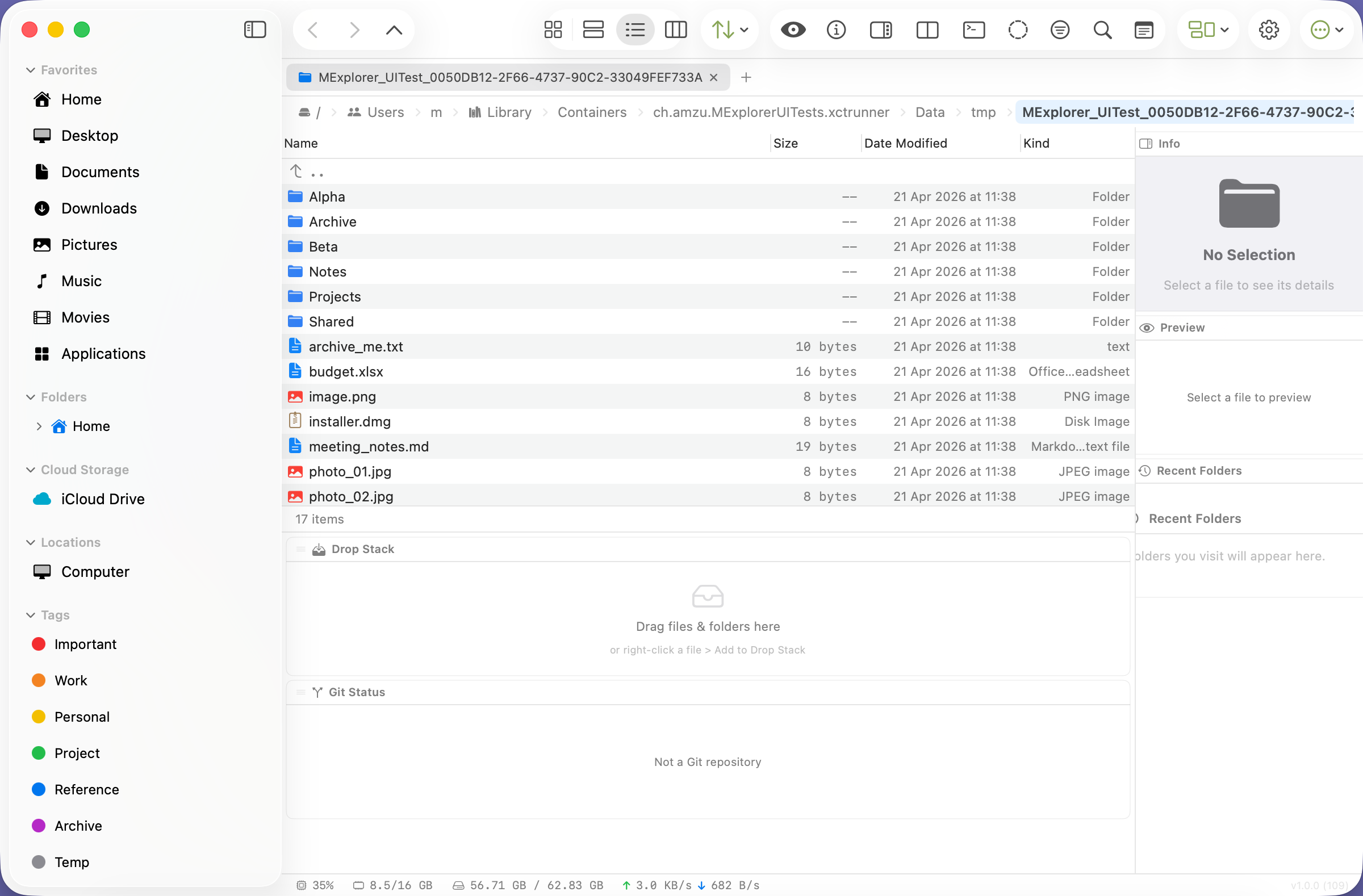
The shipping configuration: Details view, single pane, “..” row. Pick this to clear any override applied by another preset.
Server Manager
A saved-sites list in Settings → Server Manager (off by default — click Enable there) with support for SFTP, SSH, FTP, FTPS, WebDAV, SMB and AFP. Each entry carries host, port, username and a remote path; the password is stored in the macOS Keychain (kSecAttrAccessibleWhenUnlockedThisDeviceOnly) and never touches UserDefaults or plist files.
Passwords are encrypted at rest by macOS, bound to the unlocked device, keyed by the site’s UUID. Delete the site → Keychain entry wiped.
SFTP, SSH, FTP, FTPS, WebDAV, SMB/CIFS, AFP — with the right default port preselected for each.
Click Connect: SMB, AFP, WebDAV and FTP shares are mounted through macOS NetFS as regular volumes; SFTP, SSH and FTPS links are handed to the app macOS uses for them.
With the Connect to Server feature on (Settings → Features), type sftp://user@host/path or smb://server/share directly into the breadcrumb and MExplorer hands it to the OS for a one-shot connect. Go → Connect to Server… opens a dedicated prompt and remembers the last URL (password-stripped, never stored in plaintext).
Total Commander, Dolphin, Directory Opus and FreeCommander presets turn the server manager on. MExplorer Default leaves it off to keep the UI light.
The site list and the Keychain store are covered by dedicated unit tests.
Layouts & Modules
MExplorer ships with ready-made layout presets — Default, Minimal, Developer, Preview — and lets you build your own. Ten modules (terminal, hex editor, git status, metadata inspector, drop stack, file preview, info, custom actions, recent folders, transfers) can be docked left, right, bottom or hidden. The layout is remembered per preset.
Hit ⌘K to jump to files, folders, favorites and recent folders — plus a handful of common actions — from a fuzzy search. Keyboard-first, mouse optional.
A Rider-style View → Tool Windows submenu with a checkbox for every module — Terminal, Git Status, Hex Editor, Drop Stack, Metadata Inspector, Transfers, Recent Folders, File Preview and more. Flip any on or off without opening Settings; with those features enabled, Connect to Server… and Server Manager… appear at the bottom.
MExplorer registers the mexplorer:// URL scheme (mexplorer://open?path=…, &newTab=1) and writes a folder manifest for MLaunchy at ~/Library/Application Support/MLaunchy/providers/ch.amzu.MExplorer.json. The current MLaunchy does not read this manifest format yet, so the Tab-into-MExplorer integration is not working for now.
Organise bookmarks by colour-coded groups on the Home Dashboard. Drag folders onto a card to add them; group cards flow into a responsive 2–4 column grid instead of one-per-row, and each group has its own SF Symbol + TagColor picker.
Right-click MExplorer's Dock icon for one-tap access to Recent Folders, Favorites, Tags and Ratings. Settings → Dock Menu lets you toggle each section, set per-section item counts (1–20), and switch between inline rows and collapsible submenus. Every entry foregrounds the app and reuses the existing in-app drill-down code paths.
A mexplorer shell wrapper ships inside the app bundle; symlink /Applications/MExplorer.app/Contents/Resources/mexplorer onto your PATH to use it. mexplorer /Users/m opens the path; mexplorer ~/a ~/b ~/c opens three tabs. If MExplorer is already running it routes via mexplorer://open?path=…&newTab=1 instead of spawning a second process; on cold start it launches with the paths as positional args.
Settings → General → Allow only one instance (on by default) makes a second invocation forward its CLI args to the running window via the URL scheme and exit before any UI initialises. Turn off if you actively want parallel windows for split work.
View → Git Explorer… (⌥⌘G) opens a separate window with git log --graph output for the active pane's folder — commits as a scrollable table with monospace ASCII graph column, short hash, author, relative date and subject. Right-click rows to copy the SHA, copy the subject, or jump to Terminal with git show staged.
Pipe selected files to any shell command with %f, %d, %n, %e, %b placeholders. Limit actions to a file pattern, to files or to folders. Run them from the toolbar’s More menu, the Custom Actions module or the right-click Actions menu (not yet in the Details view).
Stage files from many folders, then drop them all at once — the fastest way to move scattered files.
Tap Space on any file for the system Quick Look preview — same API Finder uses.
A command line docked beside the file list. It follows your navigation, and each command runs with zsh in the folder you’re viewing — handy for quick commands, not a full terminal emulator.
A scratchpad window (View → Quick Notes) that keeps your notes across launches.
Create new Python, Swift, JSON or custom files with boilerplate in one step.
Pick any SF Symbol and color for each file type. Reset to defaults in one click.
Live CPU, memory, disk usage and network up/down at a glance.
Sort by name, size, date modified, date created or kind. Group by kind, date, size or first letter.
Pin tabs, color them, duplicate, close-others. Clickable breadcrumb path bar for instant jumps up the tree.
Drag folders into the sidebar and reorder them. A Starred section surfaces everything you’ve rated.
Icons (⌘1), Compact (⌘2), Details (⌘3), Miller Columns (⌘4) and the Thumbnail Grid (⌘5). Details renders as a native AppKit table; Miller Columns needs the Miller feature switched on; Thumbnails has a 64–512 px size slider with debounced QuickLook rendering.
⌘I toggles a detail panel with dates, dimensions, permissions and tags. A side preview pane shows the selected file’s contents live.
A module (docked at the bottom by default) shows the current folder’s git branch and a per-file M/A/D breakdown. One-click refresh.
A docked hex view of the selected file — 16 bytes per line with ASCII gutter — in addition to the full-screen F3 hex viewer.
Inspect the selected file’s type identifier (UTI), POSIX attributes and file-system resource values.
Tags you set in MExplorer are also written to the file as Finder tags, so Finder shows them too. Tags set in Finder are not imported into MExplorer.
First launch runs a five-step onboarding. A searchable in-app help browser covers navigation, views, file ops, modules and shortcuts.
Install
There is no downloadable build of MExplorer yet, and the Homebrew cask doesn’t work until the first release is published. This page will link the download as soon as it is available. Once it is out:
MExplorer.zip, unzip it and drag MExplorer.app to /Applications.
⌘T new tab · ⌘W close
⌘[ back · ⌘] forward
⌘↑ up · ⌘⇧G go to path
⌘R refresh · ⌘⇧. hidden files
⌘1/⌘2/⌘3 icons / compact / details
⌘4 columns (Miller feature on) · ⌘5 thumbnails
⌥⌘3 toggle split view
⌘I info panel · ⌘⇧P preview
⌘⇧T terminal · Space Quick Look
⌘⇧N new folder · Return rename
⌘↩ batch rename
With Commander F-keys on:
F3 viewer · F5 copy / F6 move to other pane · F8 trash
⌘F find by file name
Ctrl+I type-ahead filter
⌥⌘G Git Explorer
⌘K open palette
↑/↓ navigate · ↩ run
Fuzzy-match across actions, folders, favorites.
←/→ prev/next image
+/-/0/1 zoom · Space slideshow
⌘? help · Help → Keyboard Shortcuts
Under the Hood
No usage analytics, sessions or performance traces. Out of the box, MExplorer sends nothing.
Crash and error reports via Sentry are off by default; turn them on in Settings → Error Reporting → Send crash and error reports. Be aware: several error events (a folder that fails to load, a failed rename, trash, delete or extract) include the full file or folder path, which can contain file names and your user name.
No Accessibility, no Screen Recording. Full Disk Access is optional and strictly for exposing protected folders; Automation (Terminal) is asked only when you use Open in Terminal.
Automatic update checks are off by default (Settings → General → Updates). When on, MExplorer checks the public appcast at launch, at most once a day, and never downloads without your action.
Builds made before the opt-in change had error reports and update checks switched on by default. If you have one, check both settings above.
Native, small binary, instant launch, familiar Mac UX — no Electron, no web wrapper.
MExplorer is provided free of charge, as is, without warranty of any kind, express or implied. amzu solutions GmbH is not liable for any data loss, misplaced files or other damages resulting from use of the software.
Always keep backups of important data. Verify destructive actions (moves, deletes, batch renames) before you commit them.
If this app saves you time, consider supporting its development.
☕ Buy me a coffeeFound a bug? Email .